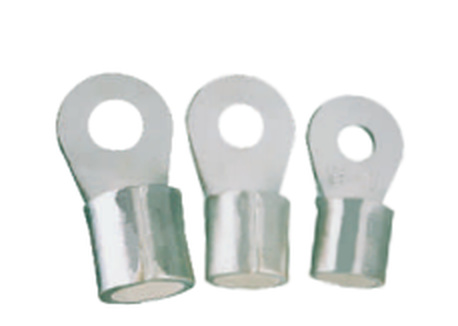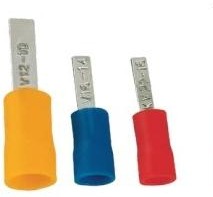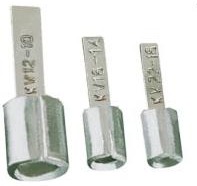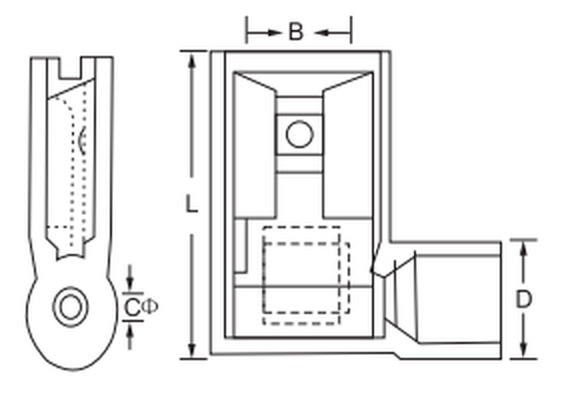





A ferrule is the least glamorous part in a control panel, and the one most often specified by habit. It is a short copper tube crimped onto the end of a stranded conductor so that the wire behaves like a solid core when it enters a terminal.
That single change fixes three problems at once.
What goes wrong without a ferrule
Push a bare stranded conductor into a screw clamp and the strands spread in a fan. Some sit under the screw, some are pushed aside, and a few break off during tightening. The joint that results has less contact area than it looks and a resistance that drifts upward with every thermal cycle.
A ferrule consolidates the strands into a round section that matches the clamp opening. The screw then bears on a solid metal sleeve instead of on loose wires.
Spring-cage terminals have the same problem in a different form: the cage pushes the strands back as it closes, so the conductor sits shallower than the installer believes.
Picking the length
Ferrule length must match the clamping depth of the terminal, not the wire strip length you happen to use.
| Ferrule length | Typical terminal |
|---|---|
| 8 mm | DIN rail terminals, small breakers |
| 10 mm | Contactors, miniature circuit breakers |
| 12 mm | Larger breakers, fuse holders |
| 18 mm | Deep fuse holders, stud connections |
| 25–40 mm | Heavy-duty lugs and busbar terminals |
A ferrule that is too short sits behind the clamp and carries no current through the joint. One that is too long protrudes past the plastic body, which is a clearance problem in dense panels and often a code violation.
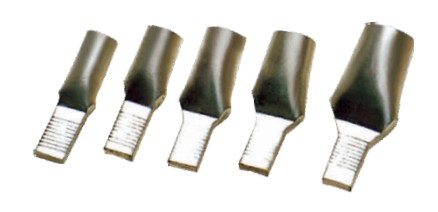
Picking the bore
The bore has to match the conductor cross-section, and it has to match the stranding class. A fine-strand flexible cable of 1.5 mm² needs a slightly larger bore than a coarse-strand 1.5 mm² building wire, because the fine strand does not pack as tightly before crimping.
The practical check is simple: the stripped conductor should slide in without forcing, and no strands should be left outside the tube. If you have to twist the wire to get it in, the bore is too small.
Why the die profile matters
Ferrules are crimped with a square or trapezoid die, not with the indent die used for terminals. The square profile produces four contact faces inside the terminal clamp and a cross-section that resists rotation.
Two things follow from that:
- A terminal crimper will not do. The indent die produces a round, single-point compression. It holds mechanically but leaves voids between the strands, and it is not the profile DIN rail terminals are tested with.
- The die has to match the ferrule size. A die that is one size large will close the tube without compressing the strands, which passes a visual check and fails a pull test.
On our own range, the pairing runs FXT2000L for 0.5–4 mm², FXT2000M for 6–16 mm², FXT2000N for 25–35 mm² and FXT2000P for 50 mm². Using the right die for the size matters more than the tool brand.
Twin ferrules
When two conductors have to land in the same terminal, a twin ferrule replaces two single ferrules with one sleeve carrying two bores. The benefits are practical: one clamp opening instead of two, both conductors held parallel, and a joint that cannot rotate out of position.
Two rules apply. Both conductors must be the same size — the bores are equal, so a mismatched pair leaves one side loose. And the crimp has to compress the whole sleeve at once; a four-indent die, not a single-wire die, and never a second bite in a different position.
Colours are not decoration
Ferrule sleeves are colour coded to the wire range. The colour is a fast visual check, not a substitute for reading the marking: white for 0.5 mm², grey for 0.75, red for 1.0, black for 1.5, blue for 2.5, yellow for 4, and so on up the range.
In a panel with several hundred joints, that colour is what lets an inspector spot a wrong ferrule before the cover goes on.
Five checks before the cover goes on
- Every stranded conductor in a clamp has a ferrule
- Ferrule length matches the clamp depth, not the strip length
- The square profile is visible on all four faces of the crimp
- No strands outside the tube at the wire entry
- Twin ferrules carry two conductors of the same size