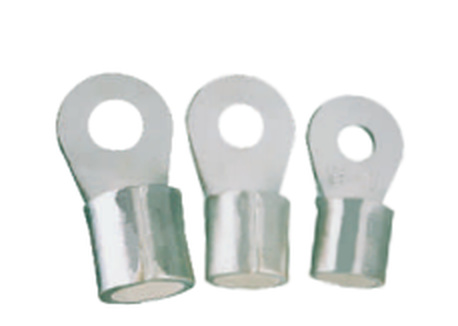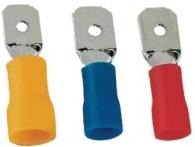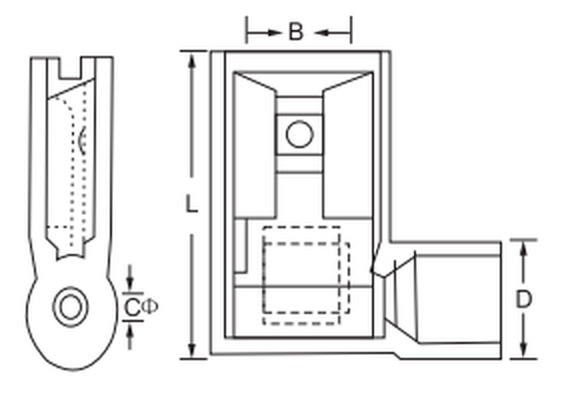





Bolting a copper lug onto aluminium cable is one of those decisions that looks fine for a year and then fails in a way nobody can explain. The joint does not melt because the lug was undersized — it fails because two different metals sat in moisture with a current flowing through them.
What actually happens at the joint
Copper and aluminium sit far apart on the galvanic series. Put them in contact, add moisture from condensation or washdown, and the aluminium becomes the anode. It corrodes preferentially, the contact resistance climbs, and the joint runs hotter. A hotter joint drives the reaction faster.
The visible sign is a white powder around the lug and a barrel that has turned brittle. The measurable sign is rising resistance under load, which is why these failures usually show up as unexplained hot spots during a thermal survey rather than as a clean break.
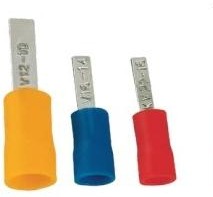
Three lug types, three jobs
| Lug | Body material | Use on |
|---|---|---|
| DT | T2 copper, tin-plated | Copper cable |
| DL | 1060 aluminium | Aluminium cable |
| DTL | Copper palm, aluminium barrel | Copper equipment to aluminium cable |
The logic is straightforward. Matching the lug to the conductor removes the galvanic couple at the crimp, which is the joint carrying the current. DT on copper cable, DL on aluminium cable, and DTL where the equipment stud is copper but the cable is aluminium.
The DTL exists precisely because the mismatch cannot always be avoided upstream: switchgear and busbars are usually copper, while the incoming cable may be aluminium. A bimetallic lug moves the transition inside the lug, where it is manufactured and sealed, instead of leaving it at a bolted interface in the field.
Why "oil-stop" barrels are not marketing
The DT and DL barrels are closed at the palm end. On paper-insulated or compound-filled cable, that closure stops the impregnation from running out through the lug under load. On ordinary XLPE cable it simply means the crimp is sealed on one end, which is never a disadvantage.
The sealed end also gives the installer a depth stop: the cable goes in until it seats, and the crimp position is then predictable from lug to lug.
Jointing compound is not optional on aluminium
Aluminium oxidises within minutes of being abraded. The oxide layer is an insulator, so a crimp made onto oxidised aluminium has a resistance that has nothing to do with the metal underneath.
The standard practice is to wire-brush the strands, apply jointing compound, and crimp while the compound is still present. The compound displaces air and oxide from between the strands and keeps them out. Skipping it produces a joint that measures acceptably at installation and degrades over the next two years.
Crimping: hex, not indent
Cable lugs above roughly 10 mm² are crimped with a hexagonal die rather than an indent die. The hex profile compresses the barrel evenly from six directions, which matters on aluminium because it work-hardens faster than copper — an uneven compression creates a hard spot and a stress riser next to it.
Two practical rules:
- Crimp from the palm end towards the cable entry, so the conductor is not pushed back out of the barrel.
- Do not re-open the die mid-cycle and do not add a second bite in a different position. On aluminium, a second bite is more likely to crack the barrel than to improve the joint.
Choosing the stud hole
Match the hole to the bolt, not to the largest washer you have:
| Bolt | Hole |
|---|---|
| M8 | 8.5 mm |
| M10 | 10.5 mm |
| M12 | 12.5 mm |
| M14 | 14.5 mm |
| M16 | 16.5 mm |
An oversized hole reduces the contact patch and lets the lug rotate under torque. On aluminium cable the rotation is worse than on copper, because the oxide film that reforms on the palm has to be broken again by the washer.
The checklist
- Conductor material confirmed before the lug is picked
- Lug material matched to the conductor, DTL where the stud is copper
- Aluminium strands brushed and compounded immediately before crimping
- Hex die matched to the cable size, crimped from palm towards cable
- Stud hole matched to the bolt, washer face clean and flat
- Joint resistance measured after installation and recorded
Most of these cost nothing at build time and are impossible to fix later.