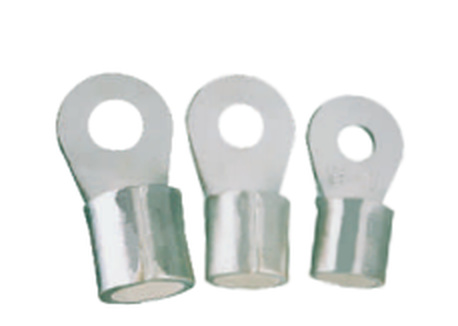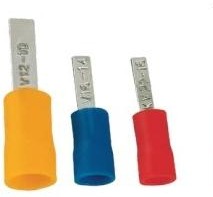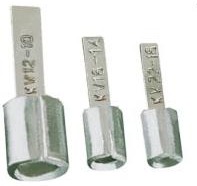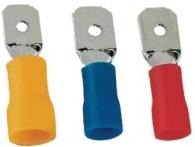





The same copper barrel sits inside both products. What changes is the sleeve around it, and that sleeve decides where the terminal can be used — not the electrical performance.
What the sleeve actually does
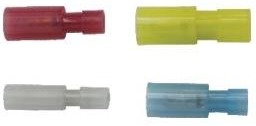
An insulated terminal adds a moulded PVC or nylon sleeve over the crimped barrel and the wire entry. It performs three functions:
- Touch protection. The live metal is covered, so the joint can sit on a panel without a separate cover.
- Strain relief. The rear of the sleeve grips the wire insulation, so flexing happens outside the barrel instead of at the crimp.
- Identification. Colour follows the wire range, which makes a wrong pairing visible during inspection.
A bare terminal has none of these. It is a copper barrel with a tin-plated finish, and whatever protection the joint gets has to be added afterwards.
Where insulated terminals win
Insulated types are the default in panel building, appliance wiring and vehicle harnesses. Three reasons:
Assembly speed. One crimp produces a finished joint. No taping, no sleeving, no second operation, and no judgement call from the operator about how much tape is enough.
Consistency. A taped joint depends on who wrapped it. A moulded sleeve is the same on every unit, which matters when the same harness is built on three shifts.
Inspection. A colour-coded sleeve tells an inspector the wire range at a glance. On a bare terminal, a 1.5 mm² and a 2.5 mm² joint look almost identical once crimped.
The limit is temperature. Standard PVC insulated terminals are rated for continuous operation around 105 °C. Heat shrink insulated types extend that to roughly 125 °C and add a moisture seal, which is why they are the usual choice for engine bays, marine decks and washdown areas.
Where bare terminals win
Bare terminals are not the cheaper, lower-grade option — they are the correct option in several situations.
Inside housings and terminal blocks. If the joint is enclosed, the sleeve adds nothing except width. A bare terminal fits into tighter spaces and leaves more room for adjacent poles.
When the assembly is covered anyway. Many harnesses are taped, braided or potted after crimping. Adding an insulated terminal means paying twice for the same protection.
Above 105 °C. Near engines, heaters and furnaces, PVC is the wrong material. A bare terminal with high-temperature sleeving or a ceramic insulator is the durable answer.
When a sheath is cheaper. A push-on sheath costs a fraction of an insulated terminal and can be fitted after the crimp is inspected. For low-volume or repair work, bare terminal plus sheath is often the practical route.
The comparison in one table
| Criterion | Insulated terminal | Bare terminal + sheath |
|---|---|---|
| Touch protection | Built in | Added afterwards |
| Assembly steps | One crimp | Crimp, then fit sheath |
| Inspection | Colour coded, visible | Neutral until sheathed |
| Continuous temperature | ~105 °C (PVC), ~125 °C (heat shrink) | Limited only by the sheath |
| Space in dense panels | Wider | Narrower |
| Rework | Cut and re-crimp | Cut, re-crimp, reuse sheath |
| Unit cost | Higher | Lower |
The mistake to avoid
The common error is not choosing between the two — it is mixing them within one harness without a rule. Half the joints insulated, half bare and taped, produces a loom where the failure mode depends on which joint you are looking at.
Pick one policy per assembly and write it into the work instruction:
- Policy A — insulated terminals everywhere, except where temperature rules them out.
- Policy B — bare terminals everywhere, with a defined sheath part number per wire size.
Either works. A mixture usually means someone ran out of one part and did not record it.
A note on colour and wire range
Colour coding is a convenience, not a specification. Red is not "1.5 mm² only" — red marks the range that the barrel was designed for. If a red terminal is crimped onto a 2.5 mm² conductor, the barrel will not close properly and the joint will pass a visual check while failing a pull test.
Match the barrel to the conductor, then read the colour as confirmation.