




Most crimping failures are decided in the first two seconds of the operation and discovered months later in the field. The defect itself is visible at the bench — it just is not being looked for.
This is a short guide to what goes wrong, what it looks like, and which check catches it.
Under-crimp
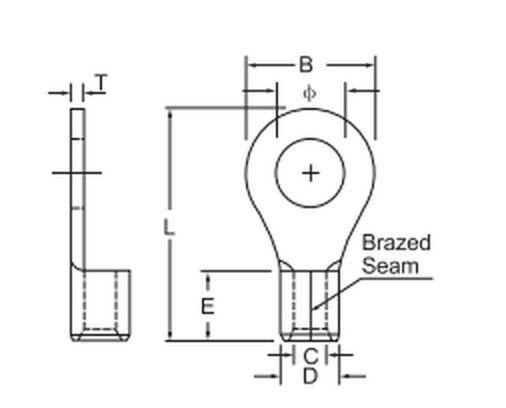
The barrel is compressed but the strands are not consolidated. Visually the crimp looks shallow, and the barrel still shows its original round contour on one or two faces.
The cause is usually a die that is one size large for the terminal, or a tool that has been adjusted to stop short of full closure to avoid cracking the insulation.
The consequence is voids between the strands. The joint holds mechanically, passes a casual tug, and heats up under load as the voids oxidise.
Catch it with: a pull test on a sample from each shift, and by checking that the die marking matches the terminal size.
Over-crimp
The barrel is flattened past its design section. The seam opens, or the barrel thins at the edge of the die and shows a bright line that becomes a crack after a few thermal cycles.
This usually comes from using a die that is too small, or from a tool that has lost its ratchet and is being closed by hand pressure alone.
Catch it with: the same pull test — an over-crimped joint often breaks at the barrel rather than pulling out — plus a visual check for a cracked seam.
Wrong die profile
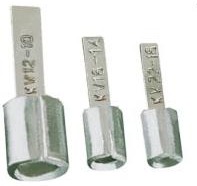
A square-profile ferrule crimped with an indent die looks perfectly acceptable: the tube is closed, the wire is inside, nothing is obviously wrong. The problem is that the cross-section is round with a single compression point, and the strands inside are not consolidated evenly.
The joint works in a bench test and behaves unpredictably in a terminal block, where the clamp bears on faces that were never formed.
Catch it with: checking the profile on a cross-section sample — four flat faces for ferrules, hex or indent for lugs, a double crimp on insulated terminals.
Wire not fully seated
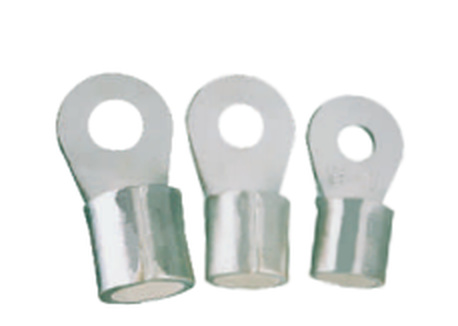
The conductor stops short of the barrel end, so only part of the crimp length carries current. On a ring terminal the crimp looks normal from the top; the gap is only visible at the wire entry.
On ferrules the same fault appears as a tube that is closed at the far end and empty near the wire.
The cause is usually strip length: too short for the barrel, or a strip that was measured against the insulation rather than the conductor.
Catch it with: a strip-length gauge at the bench and a check that the conductor is visible at the inspection end of the barrel.
Insulation support missed
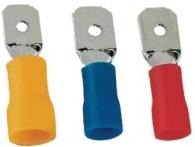
On insulated terminals the rear crimp must bite the sleeve. If the tool is set for a bare terminal, the sleeve is left loose and the wire flexes at the barrel exit.
Nothing shows up at installation. After a few thousand vibration cycles the strands break just outside the barrel — a failure that looks like a wire problem and is actually a tool setting problem.
Catch it with: a bending check on a sample; the wire should flex outside the sleeve, not at the barrel mouth.
Strands outside the barrel
Usually a bore that is too large for the conductor, sometimes a twisted wire that was forced in. The strands that sit outside the barrel carry no current and corrode first.
On aluminium this is worse: the exposed strands oxidise and the joint resistance climbs even though the crimp itself is sound.
Catch it with: a visual check at the wire entry, before the joint is insulated or sheathed.
What a routine check actually needs
Three checks, done on a sample per shift rather than on every joint:
- Visual — crimp depth, seam condition, profile, strands at the entry.
- Dimensional — crimp height or width against the tool's setting for that terminal size.
- Mechanical — pull test to the tensile value for the wire size.
The tool itself needs checking too: die condition, ratchet release, and whether the die marking still matches the job. A ratchet that releases early is the quiet cause of a whole batch of under-crimps.
None of this takes long. What it prevents is the expensive version of the same conversation, held with a customer instead of with an operator.