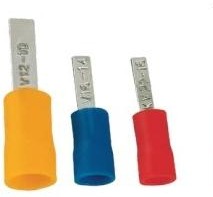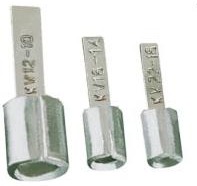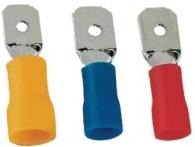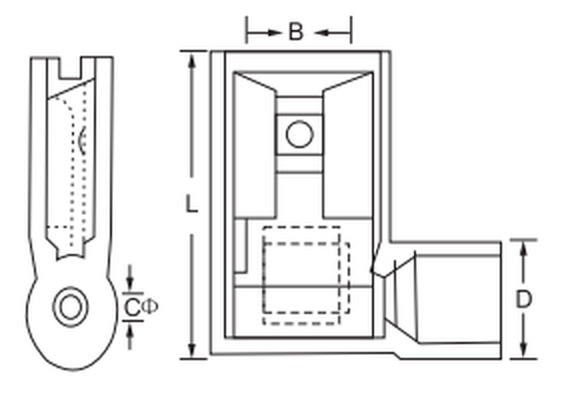





Electronic component terminals are the conductive contact points that connect a component's internal circuitry to the outside world — the PCB pad, the wire, or the mating connector. They are small, inexpensive, and easy to overlook, yet they directly determine solderability, current-carrying capacity, thermal performance, and long-term reliability.
Whether you are a design engineer selecting parts, a procurement specialist comparing suppliers, or a hobbyist learning PCB assembly, understanding terminal types and materials is essential. This guide covers everything you need to know, with comparison tables and a full FAQ section.
Quick Answer: What Is a Component Terminal?
A terminal (also called a lead, pin, or contact) is the conductive interface on an electronic component that makes electrical and mechanical connection with an external circuit. Terminals are classified by mounting method (through-hole, SMT, press-fit, wire-to-board), base material (copper alloys), and plating (tin, gold, silver).
Types of Electronic Component Terminals (Comparison Table)
| Terminal Type | Mounting Method | Typical Use Cases | Mechanical Strength | PCB Cost Impact | Best For |
|---|---|---|---|---|---|
| Through-Hole (THT) | Inserted into drilled holes, soldered on opposite side | Connectors, transformers, electrolytic capacitors | ★★★★★ (Highest) | Higher (drilling required) | High-stress, high-vibration applications |
| Surface Mount (SMT) | Soldered directly onto PCB surface pads | Resistors, capacitors, ICs, small connectors | ★★★☆☆ (Moderate) | Lower (no drilling) | High-density, automated assembly |
| Press-Fit | Pressed into plated through-holes, no solder | Backplane connectors, automotive, industrial | ★★★★☆ (High) | Moderate (tight tolerances required) | Solderless, high-reliability assemblies |
| Wire-to-Board | Crimped to wire, mated to PCB header | Cable harnesses, power connections | ★★★★☆ (Depends on housing) | Low | Field-serviceable connections |
| Screw / Clamp | Mechanical clamping of wire | Terminal blocks, industrial controls | ★★★★★ (Highest) | Low | High-current, field-wired systems |
Through-Hole Terminals (THT)
The classic "legs" inserted into drilled holes and soldered on the reverse side. They offer the strongest mechanical bond and remain the standard for components subjected to physical stress — large transformers, connectors, and power components.
Surface Mount Terminals (SMT)
Flat metal pads or "feet" (gull-wing or J-lead) soldered directly onto PCB pads. SMT dominates modern electronics because it enables high-density placement, automated pick-and-place assembly, and smaller form factors — at the cost of weaker mechanical bonds.
Press-Fit Terminals
A compliant pin (often an "eye of the needle" design) that deforms slightly to grip a plated through-hole without solder. Popular in backplanes and automotive/industrial systems where solder fatigue or thermal cycling is a concern. Requires tight control of PCB hole diameter and plating.
Wire-to-Board and Screw/Clamp Terminals
Used where a wire must connect to the board — cable harnesses, terminal blocks, and industrial controls. These prioritize field serviceability and high-current handling over miniaturization.
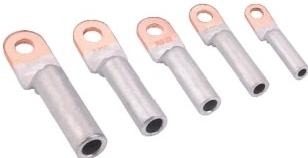
Terminal Materials and Plating (Comparison Table)
| Material / Plating | Conductivity | Corrosion Resistance | Solderability | Typical Applications | Notes |
|---|---|---|---|---|---|
| Brass (base) | Good | Moderate | Good | General-purpose terminals | Low cost, easy to machine |
| Phosphor Bronze (base) | Good | Good | Good | Spring contacts, connectors | Excellent springiness and fatigue resistance |
| Beryllium Copper (base) | Excellent | Good | Good | High-reliability contacts | Best spring properties; higher cost |
| Tin (Sn) plating | Good | Moderate | ★★★★★ (Best) | Most SMT/THT solderable parts | Whisker risk; not for fine-pitch high-rel |
| Gold (Au) plating | Excellent | ★★★★★ (Best) | Moderate (not solder-optimal) | Low-signal, high-reliability contacts | Low contact resistance; cost-sensitive |
| Silver (Ag) plating | ★★★★★ (Best) | Moderate (tarnishes) | Good | High-power, high-frequency | Best conductivity; requires care in sulfur environments |
Key takeaway: The base alloy provides mechanical strength and spring properties; the plating determines corrosion resistance, contact resistance, and solderability. Tin is the default for solderable terminals, gold for low-level signals and high reliability, and silver for power and RF.
Why Terminal Design Matters (3 Critical Factors)
| Factor | What It Affects | Design Consideration |
|---|---|---|
| Solderability | Joint reliability, defect rates | Terminal geometry must promote proper solder fillet formation; poor design causes tombstoning and cold joints |
| Thermal Management | Component lifespan, power rating | Terminals act as heat sinks — thick, large terminals are the primary heat path for power devices like MOSFETs |
| Signal Integrity | High-speed performance | At high frequencies, terminal geometry (length, width) creates parasitic inductance/capacitance affecting impedance matching |
How to Select the Right Terminal (Checklist)
- Define the mounting method — THT for mechanical strength, SMT for density, press-fit for solderless reliability, screw/clamp for field wiring.
- Check current rating — match terminal cross-section and plating to expected current; silver or thick tin plating for high current.
- Verify plating compatibility — tin for standard reflow, gold for low-signal/high-rel, silver for RF/power (avoid sulfur environments).
- Confirm the mating interface — wire gauge, connector pitch, and mating cycles for wire-to-board and connector terminals.
- Validate thermal and vibration requirements — press-fit or THT for harsh environments; check thermal cycling data.
- Review supplier qualification — RoHS/REACH compliance, UL ratings, and automotive (AEC-Q) or industrial qualifications where applicable.
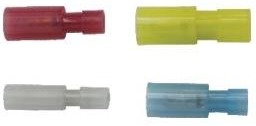
FAQ: Electronic Component Terminals
What is the difference between a terminal and a pin?
In practice, the terms are often used interchangeably. "Terminal" usually refers to the conductive contact point on a component or connector, while "pin" often refers to the physical lead on an IC or through-hole part. A connector's contacts are more commonly called terminals.
What is the difference between through-hole and SMT terminals?
Through-hole terminals are inserted into drilled holes and soldered on the opposite side, giving the strongest mechanical bond. SMT terminals are soldered directly onto surface pads, enabling higher density and automated assembly but with weaker mechanical strength. Choose THT for high-stress parts and SMT for miniaturized, high-volume designs.
Which plating is best for electronic component terminals?
It depends on the application: tin offers the best solderability for standard assembly, gold provides the lowest contact resistance and best corrosion resistance for low-signal and high-reliability contacts, and silver offers the highest conductivity for power and RF applications (though it tarnishes in sulfur-rich environments).
What are press-fit terminals and why use them?
Press-fit terminals are compliant pins pressed into plated through-holes without solder. They eliminate solder joints (and solder-related failures like fatigue and voids), making them ideal for backplanes, automotive, and industrial systems exposed to thermal cycling and vibration. They require tightly controlled PCB hole tolerances.
What causes terminal corrosion and how can it be prevented?
Corrosion is typically caused by oxidation, moisture, sulfur compounds, or galvanic effects between dissimilar metals. Prevention includes appropriate plating (gold or thick tin), conformal coating, sealed connector housings, and avoiding silver plating in sulfur-rich environments.
What is terminal current-carrying capacity and how is it determined?
Current capacity depends on terminal cross-sectional area, base material conductivity, plating, ambient temperature, and allowable temperature rise. Manufacturers publish derating curves — always derate for elevated ambient temperatures and check the connector's mated-pair rating, not just the terminal alone.
Are terminals RoHS compliant?
Most modern terminals are RoHS and REACH compliant, with tin, gold, and silver platings replacing legacy lead-based finishes. Always request the supplier's material declaration and compliance certificate, especially for automotive and medical applications.
How do I choose between wire-to-board and screw terminals?
Choose wire-to-board (crimped contacts with headers) for high-volume, compact, field-serviceable cable connections. Choose screw/clamp terminal blocks for high-current, industrial, or field-wired systems where wires are terminated on-site and repeated reconnection is expected.
Conclusion
Electronic component terminals are the bridge between a component's internal circuitry and the physical board. Selecting the right terminal type, material, and plating directly affects solderability, current capacity, thermal performance, and long-term reliability. Use the comparison tables above as a quick reference, and validate your choice against the checklist before finalizing your BOM.
Related reading: PCB Pad Design Guidelines · Solder Joint Reliability · Connector Selection Guide