




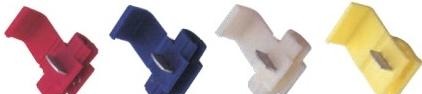
Quick Splice Connectors
QS Series quick-splice connectors use an insulation-displacement contact (IDC) that pierces the insulation of both conductors when the cap is squeezed closed, making a branch connection without stripping or tools. The colour-coded PVC housing resists oil, acids and alkalis and is rated for 600 V / 10 A.
- Material
- Flame-retardant PP, brass contact
- Wire Range
- 22–10 AWG / 0.5–6 mm²
- Models
- 878100, 878101, 878201
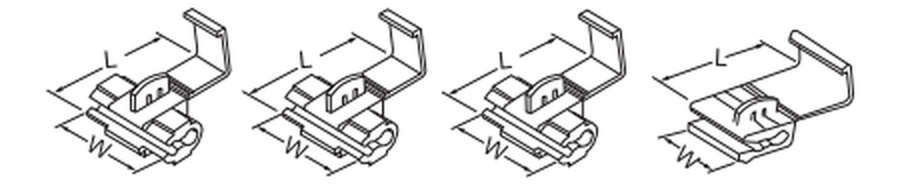
- Width (W)
- 20.0–20.5 mm
- Length (L)
- 27.0–34.5 mm
- Type
- Quick splice, insulation-displacement
- Colors
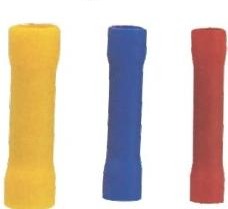
- Red, Blue, White, Yellow
QS Series Quick Splice Connectors Specifications
Complete product dimensions and model selection.
| Wire Range A.W.G. / mm² | Item No. | W (inch / mm) | L (inch / mm) | Color |
|---|---|---|---|---|
| 22–18 A.W.G. 0.5–1.0 mm² | 878100 | .787 / 20.0 | 1.063 / 27.0 | Red |
| 18–14 A.W.G. 0.75–2.5 mm² | 878101 | .787 / 20.0 | 1.063 / 27.0 | Blue |
| 18–14 A.W.G. 0.75–2.5 mm² | 878101 | .787 / 20.0 | 1.063 / 27.0 | White |
| 12–10 A.W.G. 4–6 mm² | 878201 | .807 / 20.5 | 1.358 / 34.5 | Yellow |
Product Structure & Dimensions
Get a Quote
Send us your wire size, stud size and quantity — we reply within 24 hours.
Looking for QS Series Quick Splice Connectors?
Contact our team for product specifications and quotation inquiries.
Frequently Asked Questions
How does a quick-splice connector work without stripping the wire?
A quick-splice connector uses an insulation-displacement contact (IDC). When the cap is squeezed closed, two knife blades pierce through the insulation of both conductors simultaneously and grip the copper strands inside. No stripping is required.
What wire sizes does the QS Series accept?
22–14 AWG (0.5–2.5 mm²), colour-coded red, blue and yellow.
What is the rated current and voltage?
10 A at 600 V for all three sizes.
Can a quick-splice connector be opened and reused?
No. The IDC blades permanently deform the insulation. Replace with a new connector if the branch must be remade.
Where are quick-splice connectors typically used?
Adding branch circuits to automotive lighting harnesses, adding sensors to existing machine wiring, trailer lighting taps and low-voltage signalling lines where cutting and splicing the main conductor is undesirable.