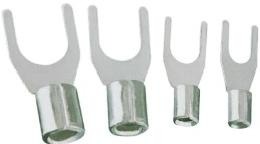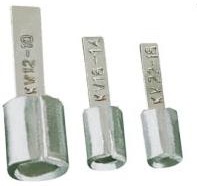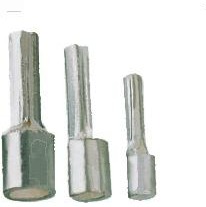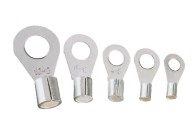





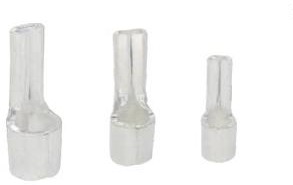
Flat Double-Layer Terminals
IT Series flat double-layer terminals accept two conductors in a stacked arrangement within a single crimp barrel. This reduces the number of connection points when two circuits share the same terminal, and the flat profile suits connectors with limited vertical space.
- Terminal Material
- Copper
- Wire Range
- 22–10 AWG / 0.5–6 mm²
- Contact Type
- Flat double-layer crimp
- Surface Treatment
- Tin-plated
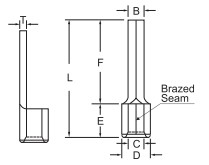
IT Double-Layer Flat Type Flat Double-Layer Terminals Specifications
Complete product dimensions and model selection.
| Item No. | B±0.3 | D±0.3 | C±0.3 | E±0.3 | L±0.5 | T±0.03 | Packaging |
|---|---|---|---|---|---|---|---|
| IT Double-Layer 4 | 3.5 | 5.0 | 3.0 | 6.4 | 19.0 | 1.0 | |
| IT Double-Layer 6 | 4.5 | 6.2 | 4.0 | 7.0 | 20.5 | 1.0 | |
| IT Double-Layer 10–5 | 5.0 | 7.8 | 5.0 | 9.0 | 24.0 | 1.2 | |
| IT Double-Layer 16–6 | 8.0 | 10.0 | 7.0 | 10.5 | 30.0 | 1.5 | |
| IT Double-Layer 25–6 | 8.0 | 12.0 | 8.0 | 12.0 | 33.0 | 1.8 | |
| IT Double-Layer 35–6 | 8.0 | 13.0 | 9.0 | 14.0 | 37.0 | 1.8 | |
| IT Double-Layer 50 | 9.0 | 15.0 | 11.3 | 14.0 | 37.0 | 1.8 | |
| IT Double-Layer 70 | 15.0 | 17.5 | 12.5 | 24.0 | 55.0 | 2.2 |
Product Structure & Dimensions
Get a Quote
Send us your wire size, stud size and quantity — we reply within 24 hours.
Looking for IT Double-Layer Flat Type Flat Double-Layer Terminals?
Contact our team for product specifications and quotation inquiries.
Frequently Asked Questions
What is a flat double-layer terminal?
A flat double-layer terminal is a crimp contact that holds two wire conductors in a stacked arrangement within a single barrel. This eliminates one terminal and one bolt position when two separate circuits must land at the same point.
What wire sizes are accepted?
22–10 AWG (0.5–6 mm²) per conductor.
How is a double-layer terminal different from a twin wire ferrule?
A twin wire ferrule (TE Series) holds two wires side by side for insertion into a single terminal block port. An IT double-layer terminal is a lug or disconnect with two crimp positions stacked vertically.
Is the connection as reliable as two separate terminals?
Yes, provided the correct die is used for the double-barrel cross-section. Each conductor receives its own independent crimp indent.
What tool is required?
Use an FXT Series ratchet tool with a double-barrel die, available from the same range as single-barrel tools.