



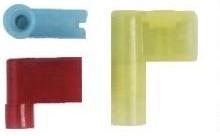
Flag Terminals
FLDNY Series flag terminals exit the wire at 90° to the tab, so the crimped wire runs parallel to the mounting surface rather than doubling back. This reduces bend stress on the conductor and saves space in crowded panel wiring. Colour-coded nylon or PVC sleeve for 22–10 AWG.
- Terminal Material
- Copper (tin-plated)
- Insulation Material
- Nylon / PVC
- Wire Range
- 18–10 AWG / 0.75–6 mm²
- Models
- FLDNY1.25-250(8), FLDNY2-250(8), FLDNY5.5-250(8)
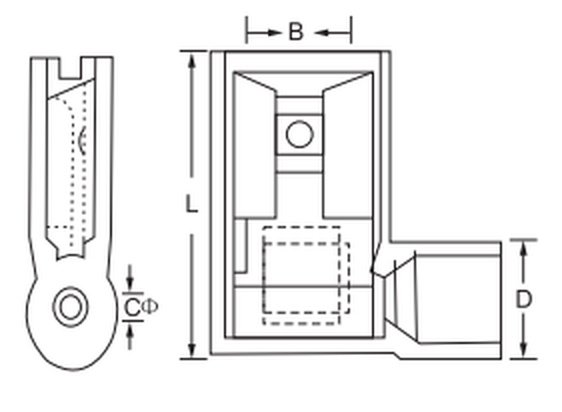
- Tab Width (B)
- 6.6–7.0 mm
- Length (L)
- 16.3–23.0 mm
- Tab Angle
- 90° (flag / right-angle)
- Packaging
- 500 PCS
FLDNY Series Flag Terminals Specifications
Complete product dimensions and model selection.
| Item No. | Applicable Wire AWG | Dimension (mm) | Packaging | |||
|---|---|---|---|---|---|---|
| B±0.3 | L±0.5 | ΦD±0.3 | C±0.3 | |||
| FLDNY1.25-250(8) | 18–16 (0.75–1.5) | 6.6 | 16.3 | 4.25 | 1.7 | 500 PCS |
| FLDNY2-250(8) | 16–14 (1.5–2.5) | 6.6 | 16.3 | 4.6 | 2.3 | |
| FLDNY5.5-250(8) | 12–10 (4–6) | 7.0 | 23.0 | 6.3 | 3.4 | |
Product Structure & Dimensions
Get a Quote
Send us your wire size, stud size and quantity — we reply within 24 hours.
Looking for FLDNY Series Flag Terminals?
Contact our team for product specifications and quotation inquiries.
Frequently Asked Questions
What is the advantage of a flag terminal over a standard blade terminal?
A flag terminal routes the wire at 90° to the tab, so the cable lies flat against the mounting surface. This eliminates the reverse loop that a standard blade terminal forms when the wire must run parallel to the panel, saving space and reducing stress on the conductor insulation.
What wire sizes does the FLDNY Series accept?
22–10 AWG (0.5–6 mm²), colour-coded red, blue and yellow.
Is the insulation material nylon or PVC?
FLDNY Series flag terminals use nylon insulation, which is rated to 105 °C and is more chemical-resistant than PVC.
What tab widths are available?
2.8 mm, 4.8 mm and 6.3 mm, matching standard quick-disconnect receptacle families.
How are they crimped?
Use an FXT Series ratchet tool for the wire cross-section, the same tool as for other blade-disconnect terminals.