




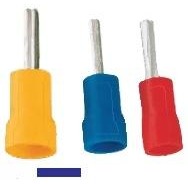
Pin Insulated Terminals
PTV Series pin insulated terminals end-mount stranded copper wire with a solid round pin that plugs directly into relay sockets, PCB connectors and spring-cage blocks. The PVC sleeve is colour-coded to wire cross-section. Suitable for 22–10 AWG and rated for 600 V.
- Terminal Material
- Copper
- Insulation Material
- PVC
- Wire Range
- 22–10 AWG / 0.5–6 mm²
- Insulation Colors
- Red, Blue, Black, Yellow
- Pin Diameter
- 1.0 mm / 1.2 mm / 1.5 mm
PTV Series Pin Insulated Terminals Specifications
Complete product dimensions and model selection.
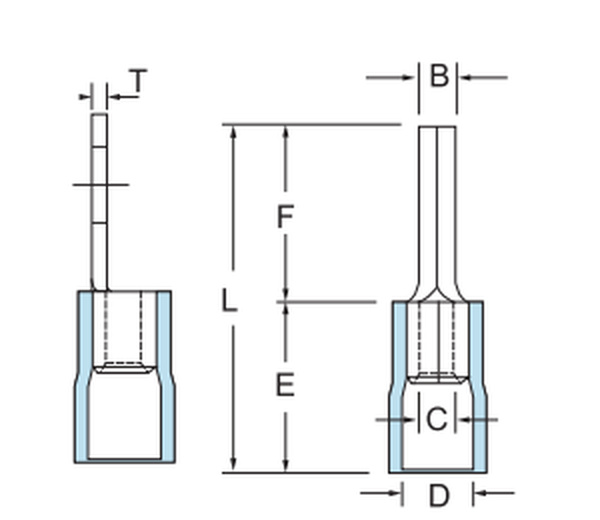
| Wire Range | Item No. | B (mm) | L (mm) | E (mm) | D (mm) | C (mm) | T (mm) | Color | Packaging |
|---|---|---|---|---|---|---|---|---|---|
| 22–16 AWG 0.5–1.5 mm² |
PTV1.25-10 | 2.0 | 20.5 | 10.5 | 4.0 | 1.7 | 0.75 | Red | 500 PCS |
| PTV1.25-13 | 2.0 | 23.5 | |||||||
| PTV1.25-18 | 2.0 | 29.5 | |||||||
| 16–14 AWG 1.5–2.5 mm² |
PTV2-10 | 2.0 | 20.5 | 10.5 | 4.5 | 2.3 | 0.80 | Blue | |
| PTV2-13 | 2.0 | 23.5 | |||||||
| PTV2-18 | 2.0 | 30.5 | |||||||
| 12–10 AWG 4–6 mm² |
PTV5.5-13 | 2.8 | 28.0 | 13.5 | 6.3 | 3.5 | 1.00 | Yellow | 250 PCS |
| PTV5.5-18 | 2.8 | 35.0 |
Product Structure & Dimensions
Get a Quote
Send us your wire size, stud size and quantity — we reply within 24 hours.
Looking for PTV Series Pin Insulated Terminals?
Contact our team for product specifications and quotation inquiries.
Frequently Asked Questions
What are PTV Series pin insulated terminals used for?
PTV Series pin insulated terminals terminate stranded copper wire with a solid round pin that plugs directly into relay sockets, PCB connectors and push-in spring-cage terminal blocks. The PVC sleeve prevents the wire strands from fanning out during insertion.
Which wire sizes does the PTV Series cover?
The series spans 22–10 AWG (0.5–6 mm²), colour-coded red (0.5–1.5 mm²), blue (1.5–2.5 mm²) and yellow (4–6 mm²).
What pin diameters are available?
Pins of 1.0 mm, 1.2 mm and 1.5 mm outside diameter are available to match the socket pitch of the target connector.
Are PTV terminals interchangeable with European DIN 46228 ferrules?
No. PTV terminals are discrete pin connectors, not wire ferrules. For ferrule applications use the GT or E Series.
How tight should the crimp be?
Use a calibrated ratchet tool — the crimp must not be loose or over-crimped. A finished crimp should withstand a minimum pull-out force per IEC 60947-7-1 for the conductor cross-section.